Below you can find the official marking criteria for the cross-media assignment.
Click image to enlarge.
Click read more to see the assessment criteria (how marks/grades are awarded) for THIS assignment.
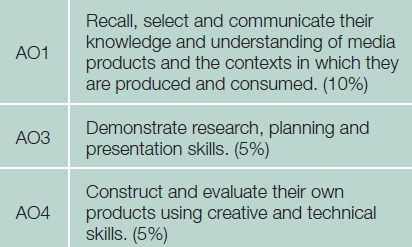
These are the 'Assessment Objectives' that marks are awarded for on the coursework unit
A reminder of how this fits in to the overall coursework unit:
How the exam board describe this assignment. Note - the Key Concepts of Media Language and Audience are highlighted ... but you can reflect on Representation and Institution too!
This is the exam broad brief for the magazine task we work on:
The 'EXPLANATION'
This should be around 150 words of an overall 700 word maximum.
The key goal is to detail (denote) your Media Language choices and analyse WHY you chose these: how your media language would attract a specific audience/s (primary, secondary).
To help back up your analysis, you can reference examples of magazine covers - this doesn't have to be just the one you have submitted.
You should use SMALL images to help illustrate your points: parts of your/existing mag covers to directly illustrate a point.
Remember that Media Language includes terms specific to magazines; shot types, angles, lighting, mise-en-scene; fonts; semiotics; audience terms/theories, etc.
Below - click read more for the actual assessment criteria:
SOYLENT GREEN (Richard Fleischer, 1973)
Takes the theme of eco-disaster and the consequences...
FULL FILM
TRAILER
2001: A Space Odyssey (Stanley Kubrick, )
See multiple videos here or on the sidebars of the videos below.
Containing one of the most famous scenes in cinema:
An AI gone rogue ("I'm sorry Dave, I can't do that...")
Another legendary scene of space exploration...
Here's the 2014 re-release trailer
An analysis of why THIS is the MOST IMPORTANT SCI-FI FILM EVER MADE!
MOON (Duncan Jones, )
Important example of how convincing and effective LOW BUDGET sci-fi can be now; because of digitisation and convergence, VFX/SFX and CGI are accessible...
See multiple video features here.
Trailer:
Columbia Pictures (also known as Columbia Pictures Industries, Inc.) is an American film production and distribution studio of the Sony Pictures Motion Picture Group,[1] a division of Sony Pictures Entertainment, a subsidiary of the Japanese conglomerateSony.[2] It is one of the leading film studios in the world, a member of the so-called Big Six. [Wiki]
Original theme tune.
Original 1984 trailer.
Matrix used sci-fi green for its title sequence [Reloaded] (and the company ident also). Dr Who intertextuality?
Full Ghostbusters trailer.. the most hated in history?!
You can find more than just trailers on YouTube: many older films, now out of copyright, are viewable in full, plus many more recent examples (rights holders get paid for advertising that YouTube inserts).
The following YouTube search will bring up multiple playlists of full movies:
I've created playlists using some of these, plus newer examples (trailers, not full movies) - you can create your own too to help with your research (you could save features, documentaries etc as well as films/trailers).
The links below are for BBFC pages, explaining why they got this rating - all the same bar the last two...
We will use this 1950 movie (Destination Moon) as an example for initial analysis, thinking about issues such as representation of gender, business/government, enemy/threat/'the other', mise-en-scene...
This is a better known 'classic':
This one you may have read!
Hybridity isn't a new idea...
A good example of how postmodern irony has become common - and how some movies do target an older primary target audience!
The 'Key Concept' of Audience is introduced through Assignment 1, and needs to be addressed in all 3 assignments! Media coursework, and real-world media production, always requires a clear definition of the target audience:
marketing a media product requires carefully selected advertising
the audience of a TV show/channel (the ad breaks between programmes), or a movie (trailers), magazine (posters) etc needs to be similar to that targeted by the movie otherwise a LOT of money will be wasted!
(TIP: magazines especially will offer detailed breakdowns of their readership [audience] on the publisher website as otherwise advertisers wouldn't pay - it would just be a random gamble without that information!)
the text's media language + production choices will be shaped by target audience: you won't cast a mainly 40+ cast if you want to appeal to a youth audience; you won't include sexual or violent content or swearing that would lead to a UK BBFC age rating of 18 if you want to target a wide mainstream audience
audience will always be split into two: primary and secondary (a secondary target audience is often older)
we can also consider mainstream or niche appeal
we would usually define at least an age range, gender(s) and social class (ABC1C2DE) - sophisticated, complex texts are often aimed at ABC1s, while simpler texts might be aimed at a less educated and less wealthy C2DE audience
applying specific terms and theories like uses and gratifications, or linked narrative concept such as narrative enigma, is important
media productions always reflect business thinking, so we get terms like the four quadrant strategy
You can also find a complete online course, with videos of lectures, at http://virtual-sf.com/.
6 classic sci-fi films. Reading is important ... but so is VIEWING!!!
I'll be adding more online sources you can access. Some of the following will be available through the Library shortly. You can find a huge list of books and articles at this US university's Library website.
Used for fictional works that rely on advanced technology, scientific development, or encounter with alien life, to make the narrative possible. Stories frequently have a prophetic nature, forecasting how technological changes may impact society in the years to come. The likely future is often seen as dehumanized, dystopian, or post-apocalyptic. May be set on both Earth or in outer space, and (most often) in the future, although sometimes set in the present or past. Horror may overlap with Science fiction when advanced technology or alien life prove malevolent and terrifying. [WorldCat]
One of your key research tasks is to come to a clear, detailed definition of the genre ... but you will find that there are many opinions on this ... The above quote is a good starting point. Start to consider which films provide examples of fitting this ... and any that might challenge it!!!
BFI (British Film Institute) - detailed and not an easy read, but very useful. You will also find detailed reviews of many sci-fi films linked along the right.
Thanks to Ismini for passing on this link, a very useful example that contains analysis of multiple posters and trailers, and also breaks down much of the planning involved in creating these texts too.
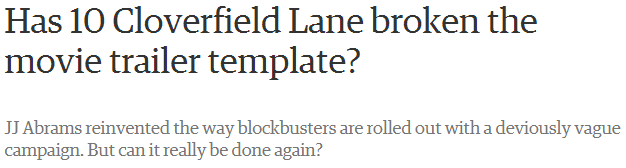
Benjamin Lee discusses how the unconventional marketing for 10 Cloverfield Lane has broken all the rules of film promotion ... and succeeded - on a low budget, (major) star-free production. You could reflect on this as part of evidencing your grasp of (Key Concept) Institution - the article explores both the industry typically works and the countertypical approach for this JJ Abrams movie.
Here's a sample:
The roll-out of a new trailer has become a tiresome exercise. Ten-second teasers precede a 6o-second teaser, which is followed by a two-minute trailer, accompanied by another two-minute international trailer, and perhaps finished off with some TV spots and a final internet-only trailer.
Read more yourself: all exam board guides are here.
They are free and accessible to parents and students.
There are two units, exam (40%, you sit this in Year 11) and coursework (3 assignments, we do 1 and 2 in Year 10, and start Year 11 with assignment 3).
What you should gain from the GCSE.
What marking is based on - the four Assessment Objectives. See additional posts for specifics on each assignment.
There are four 'Key Concepts', major areas of media theory and learning.
Coursework assignment 1 (Introduction to the Media: currently magazine) requires evidence on Media Language + Audience, but you may also reflect on Representation + Institution. Coursework assignment 2 (Cross-Media: currently film poster + teaser trailer) requires evidence on Representation + Institution, but you should reflect some knowledge and understanding of Media Language + Audience too. Coursework assignment 3 (Production and Evaluation: currently website) requires evidence of learning on all 4 KCs.
The exam topic is set in advance, so you can start exploring this as soon as you like - you don't need to wait until we start lessons in this towards the end of Year 11!
A summary of exam content and each assignment is contained in separate posts
Read more yourself: all exam board guides are here.
They are free and accessible to parents and students.
This is a controlled assessment.
That means you get the exam paper FOUR WEEKS IN ADVANCE.
You will receive the 2018 briefing paper on Monday May 7th, then have 4 weeks to research and draft answers to revise from. EXAM: Monday 4th June, 930-11 (11:22 with 25% extra time) in ?ZB15 [tbc].
Your teacher cannot teach directly on answering this, but only on the topic for that year:
2016: science fiction films 2017: TV game shows 2018: serial TV drama
You have 4 weeks to research and prepare your responses to the FOUR exam questions.
You cannot take any notes into the exam - you will get a new copy of the briefing paper in there.
This will involve a practical task, such as storyboarding or sketching a layout (of a poster, magazine, webpage etc) and a creative task (coming up with ideas for new texts), as well as requiring evidence of your knowledge and understanding of the Key Concepts, the research you have undertaken to build this, and ability to apply these to the topic.
Research resources will appear on this blog in advance of the exam; you can start exam preparation independently at any time.
MARKING: THE ASSESSMENT OBJECTIVES
Marks are awarded for the following:
HOW THE EXAM PAPER LOOKS
Below (click read more) you will find images from past papers, including the resource book you get with this.
**CLICK READ MORE AND SCROLL TO THE BOTTOM FOR EXAM BOARD FULL MARK EXAMPLES**
Read more yourself: all exam board guides are here.
They are free and accessible to parents and students.
Below you can find the official marking criteria for the cross-media assignment.
Click image to enlarge.
Click read more to see the assessment criteria (how marks/grades are awarded) for THIS assignment.
These are the 'Assessment Objectives' that marks are awarded for on the coursework unit
A reminder of how this fits in to the overall coursework unit:
How the exam board describe this assignment. Note - the Key Concepts of Institution and Representation are highlighted:
This is the exam broad brief for the film promotion cross-media task we work on:
THE 200 WORD EXPLANATION
Official guidance on this is very brief:
Candidates should explain in no more than 200 of the
1000 - 1200 words allocated, how their two research,
planning and production tasks are connected and
how effective they are. They should also comment
on how they have addressed representational and
institutional issues.
So, you should include:
how your research influenced your own production
how effective/convincing your productions are
apply Key Concept Representation to your work
apply Key Concept Institution to your work
Below - click read more for the actual assessment criteria:
Year 11: Lesson Thursday 9th March You need to plan and storyboard (filming, editing aren't required) a teaser trailer to accompany your poster; you will then be comparing the two texts, using terms from the Key Concepts Media Language and Audience, but also Representation and Institution to do so. As always, you need to first research and summarise the conventions of the media format. You will re-pitch your film idea (many of you are changing this from your Year 10 idea) next week (we will look at what is required on Friday).
Today, follow the instructions below; the Word worksheet you need is embedded further down in this post.
HOMEWORK for Friday: Have completed analysis, using the worksheet, of 3 teaser trailers from different genres. This will be more useful if you discuss with each other and try to look at different trailers.
HOMEWORK for Thursday 16th: Have emailed your teaser trailer conventions summary presentation.
HOMEWORK for Friday 17th: Have emailed PowerPoint for your re-pitch.
TASK: View and analyse 3 teaser trailers from different genres, using the handout for note-taking, then share and add notes for two more from two different students. Summarise your findings.
Use the template below. Seek to apply your media language terms and learning - including some semiotic terms.
Add a summary to the end of each trailer analysed, a good opportunity to use media language and semiotic terms (connote, denote; signifier, signifiedetc):
HOW AUDIENCE IS SIGNIFIED: what audience do you think this is aimed at (gender, age range), and why do you think this (provide evidence from the trailer) HOW GENRE IS SIGNIFIEDwhat genre do you think this is and how has it been signified (provide evidence from the trailer)
PRESENTING CONVENTIONS RESEARCH (Tuesday 8th lesson; complete + email for Monday 14th)
You are limited in the amount of evidence you can present [see assessment criteria], so you need to combine image and concise, precise text well. This evidence needs to showcase your wider learning, not simply list your observations on the common conventions of a media format.
You will be DRAFTING an outline of your INITIAL findings today - we will later focus on a comparison of the two media formats, poster and teaser trailer. We will also review your trailer conventions findings and look more deeply at how to apply the Key Concepts:
(building on Assignment One) Media Language [shot types, angles, semiotics]
Audience [primary, secondary, uses + gratifications; gender, age, four quadrant]
(introduced through Assignment Two) Representation (stereotype, countertype)
SUMMARY: Using Word, Publisher, PowerPoint or Photoshop, extract and save screenshots from the teaser trailers you have analysed to illustrate a list of what you consider to be the conventions of this media format.
SCREENSHOTS:On L17 PCs, use the 'snip' tool to bring up the option of dragging around the area you want to screenshot. Click:
Windows [start menu, bottom left of the screen]
All programs
Accessories
Snipping
When you drag round to select the area you want, let go; hold CTRL and press S to save - set up a folder for each film or convention; give the file a clear, specific name so you will know when you come back to this what each image is, for example: Avatar star billing
If you're making a point about use of ('non-diegetic')* voiceover, a screenshot isn't necessary.
For a point on how sound is used with editing, take a screenshot of the moment when a loud sound effect is applied.
*sound is diegetic if it comes from the world on screen: someone speaking or music through a hi-fi for example (it/they might not be in shot - use your judgement); if the sound is not from the scene on screen (eg music soundtrack, often as an audio bridgelinking different scenes) it is non-diegetic[pronounced die-uh-jet-ic]
APPLYING MEDIA TERMINOLOGY
As you put these together in Word (etc), identify the shot type, angle, and seek to apply semiotic terms (denote, connote; signifier, signifiedetc) where you can.
Where there is a clear link to Institution (stars and budget/box office, director and their previous films etc), include some evidence of research. Don't simply rely on your observations!
RESEARCH RESOURCES:
There are multiple posts on this blog which can help, as well as your handouts and notes.
There are several ways of finding out a film's box office and budget.
The Wiki often gives this, but isn't always reliable - if using this, hover over the link given beside any figure and click through to it to check the figure is right.
BoxOfficeMojo gives you a global figure but also breaks it down by country, which can be very useful. IMDB gives budget, box office, cast/crew and more - you can find out what else cast/crew (and companies) have done here. The-Numbers is similar to BoxOfficeMojo, a data (box office) driven site, but provides more extras.
RESEARCHING CONVENTIONS (Monday 7th lesson)
TASK: View and analyse 3 teaser trailers from different genres, using the handout for note-taking, then share and add notes for two more from two different students. Summarise your findings.
Use the template below. Seek to apply your media language terms and learning - including some semiotic terms.
Add a summary to the end of each trailer analysed, a good opportunity to use media language and semiotic terms (connote, denote; signifier, signifiedetc):
HOW AUDIENCE IS SIGNIFIED: what audience do you think this is aimed at (gender, age range), and why do you think this (provide evidence from the trailer) HOW GENRE IS SIGNIFIEDwhat genre do you think this is and how has it been signified (provide evidence from the trailer)
Alongside the film poster, to evidence a cross-media campaign, and a grasp of the conventions of this, you need to also work on a teaser trailer for your film concept.
You do not need to actually produce this (but can do so, and this would be useful experience); clear planning materials, particularly highly detailed storyboards, will suffice.
You can research conventions by finding a range of examples to view
I will be gathering resources below to help you with this, an ongoing process.
You can go to the major film studios' YouTube channels and search for 'teaser trailer' in these, for example, I did this with Warner Bros.
If you have a google account you can set up your own YouTube channel - useful for creating your own playlists of trailers you want to study, as I have done:
Read more yourself: all exam board guides are here.
They are free and accessible to parents and students.
Below you can find the official marking criteria for the cross-media assignment.
Click image to enlarge.
Click read more to see the assessment criteria (how marks/grades are awarded) for THIS assignment.
These are the 'Assessment Objectives' that marks are awarded for on the coursework unit
A reminder of how this fits in to the overall coursework unit:
How the exam board describe this assignment. . Note - all 4of the Key Concepts of Media Language, Audience, Representationand Institution (MARI) are highlighted:
This is the exam broad brief for the website task we work on:
This describes suggested minimums.
Below - click read more for the actual assessment criteria:
Along with semiotic terms (signifier, signify, signified, denote, connotationetc) and media language terms (shot types, anglesetc), you can also challenge yourself to use a little bit of theory.
'AIDA' is a common concept within the marketing and design industry - the resources below will help you identify what this is, and should help you create a smarter poster that is higher impact with your audience ...
WEBDESIGNERDEPOT
This page uses lots of very clear examples and builds 'AIDA' into a 7-step design process.
Think about how the examples below use smart semiotics to tell the story; they encode the meaning through smart use of imagery which work as signifiers, connoting the genre and the theme of sex appeal. The image choice also suggests, or denotes, a female lead. The tagline helps, but isn't too obvious and doesn't clumsily provide anchorage for the otherwise polysemic meaning.
[if any of that is confusing, just ask me to go through it!]
The PowerPoint below uses elements from this website to look at the same idea.
You can find very specific guides online to create all sorts of effects and types of text, and this includes lots of guides for film posters generally, and also for particular film styles or FX.
JUSTCREATIVE - THE PROCESS, AND A SAMPLE TEMPLATE TO EXPERIMENT WITH
This designer includes images you can work with to follow his instructions, and he guides you the design process - including drafting, getting audience feedback, and then re-drafting, making it clear what changes were made and why!
You too should be able to picture your final poster as a huge display in public!
VANDELAYDESIGN - 39 SPECIFIC GUIDES
There is a very wide range of step by step tutorials: sci-fi, 80s, 60s, Lord of the Rings, Indiana Jones ...
Making a convincing action poster is challenging; this guide could help you achieve that!
CLICK READ MORE below TO SEE MORE LINKS AND EXAMPLES